Travel
Thai Market Phrases: Prices, Bargaining and Shopping for Clothes
Published · 7 min read
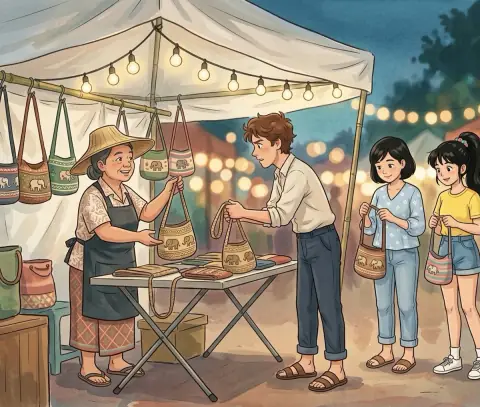
To shop at a Thai market, point at what you want and ask อันนี้เท่าไหร่ an-níi tâo-rài, “how much is this?”. To bargain, smile and ask ลดได้ไหม lót dâai mǎi, “can you lower the price?”. When you have decided, say เอาอันนี้ ao an-níi, “I’ll take this one”, and if you are only browsing, ดูก่อน duu gɔ̀ɔn, “just looking first”. End each sentence with ครับ kráp (male speaker) or ค่ะ / คะ kâ / ká (female speaker).
Those four sentences get you through most markets in Thailand, from the morning fresh market in your soi to a night market full of clothes and bags. This article adds what comes around them: units and classifiers, the unwritten rules of bargaining, sizes and colors, and how to pay.
How to ask the price in Thai
| Thai | Transliteration | Meaning |
|---|---|---|
| อันนี้เท่าไหร่ | an-níi tâo-rài | How much is this (one)? |
| ราคาเท่าไหร่ | raa-kaa tâo-rài | What is the price? |
| กี่บาท | gìi bàat | How many baht? |
| กิโลละเท่าไหร่ | gì-loo lá tâo-rài | How much per kilo? |
| ทั้งหมดเท่าไหร่ | táng-mòt tâo-rài | How much altogether? |
เท่าไหร่ tâo-rài is also spelled เท่าไร; you will see both, and they are pronounced the same. Thai puts the question word at the end of the sentence, so “this one, how much?” is the natural word order.
The answer usually comes as a bare number, without บาท bàat: ห้าสิบ hâa-sìp means 50 baht. Vendors also shorten round prices in a way that catches beginners out: ร้อยห้า rɔ́ɔi-hâa is usually 150 (short for ร้อยห้าสิบ), and พันสอง pan-sɔ̌ɔng is 1,200. If you are not sure, ask them to repeat or type it on a phone or calculator, which vendors do all the time. To read prices comfortably, start with our guide to Thai numbers.
Kilos, “per” and pieces
Fruit, vegetables and meat are sold by weight; clothes and objects by the piece. The little word ละ lá, “per”, links the two: unit + ละ + price.
| Thai | Transliteration | Meaning |
|---|---|---|
| กิโล | gì-loo | kilo (often shortened to โล loo) |
| ครึ่งกิโล | krʉ̂ng gì-loo | half a kilo |
| ขีด | kìit | 100 grams |
| กิโลละร้อย | gì-loo lá rɔ́ɔi | 100 baht a kilo |
| อันละยี่สิบ | an lá yîi-sìp | 20 baht each |
| สามตัวร้อย | sǎam dtua rɔ́ɔi | three (shirts) for 100 |
ขีด kìit is very handy for small amounts: สองขีด sɔ̌ɔng kìit is 200 grams of chilies, nuts or dried fruit.
When you count items, Thai uses a classifier after the number, chosen by the kind of object: เอาสองอัน ao sɔ̌ɔng an (“I’ll take two”). The ones you meet at the market:
| Classifier | Transliteration | Used for |
|---|---|---|
| อัน | an | small objects; the safe default |
| ชิ้น | chín | pieces (a slice of cake, an item of clothing) |
| ตัว | dtua | clothes (shirts, trousers) and animals |
| ลูก | lûuk | round fruit (mangoes, coconuts) |
| ใบ | bai | bags, hats |
| คู่ | kûu | pairs (shoes, socks) |
| ถุง | tǔng | a bag of something |
If you forget the right one, อัน an is understood almost everywhere. The full system is in our article on Thai classifiers.
How to bargain politely in Thai
Bargaining in Thailand is a friendly game, not a fight. It is expected at clothes, souvenir and night markets; it is done with a smile; and the discount is usually modest.
| Thai | Transliteration | Meaning |
|---|---|---|
| ลดได้ไหม | lót dâai mǎi | Can you lower the price? |
| ลดหน่อยได้ไหม | lót nɔ̀i dâai mǎi | Can you lower it a little? (softer) |
| แพงไป | pɛɛng bpai | It’s too expensive |
| ถูกหน่อยได้ไหม | tùuk nɔ̀i dâai mǎi | Can it be a bit cheaper? |
| ร้อยได้ไหม | rɔ́ɔi dâai mǎi | Would 100 be OK? |
| ถ้าซื้อสองอัน ลดได้ไหม | tâa sʉ́ʉ sɔ̌ɔng an, lót dâai mǎi | If I buy two, can you give a discount? |
| แถมได้ไหม | tɛ̌ɛm dâai mǎi | Can you throw something in for free? |
| ตกลง | dtòk-long | Deal, agreed |
หน่อย nɔ̀i (“a little”) is the magic word: it turns a demand into a gentle request. ไป bpai after an adjective means “too”: แพงไป is “too expensive”, not just “expensive”.
A typical exchange goes like this:
- Ask the price: ตัวนี้เท่าไหร่ครับ dtua-níi tâo-rài kráp (for a shirt).
- React lightly, smiling: แพงไปนิดหน่อย pɛɛng bpai nít-nɔ̀i, “a bit too expensive”.
- Ask for a discount, or propose a price: ลดหน่อยได้ไหม, then ร้อยห้าสิบได้ไหม rɔ́ɔi-hâa-sìp dâai mǎi.
- Close the deal with ตกลง dtòk-long or เอา ao, or leave politely with ไม่เป็นไรครับ ขอบคุณ mâi-bpen-rai kráp, kɔ̀ɔp-kun.
You will hear vendors answer with ได้ dâai (“OK”), ไม่ได้ mâi dâai (“can’t”), ลดให้แล้ว lót hâi lɛ́ɛo (“I’ve already lowered it for you”) or ขาดทุน kàat-tun (“I’d be losing money”). Buying several items is the most reliable lever: in the story The night market, Hugo gets two bags for four hundred baht and a free bow with แถม tɛ̌ɛm. His very first haggle, over mangoes, is in At the market.
When not to bargain
Bargaining in the wrong place is awkward for everyone. Prices are fixed in:
- 7-Eleven, supermarkets and malls. The price on the label is the price. Hugo tries anyway in the story At the mall, without success.
- Food stalls and restaurants, especially when prices are on a board. Street food margins are small, and a plate is already cheap.
- Small everyday items at the fresh market. Haggling over five or ten baht on vegetables comes across as stingy.
At a fresh market, rather than a discount, people sometimes ask for a little extra: a few more chilies or a handful of herbs thrown in.
Buying clothes: sizes, colors and trying on
At a clothes stall, shirts and trousers take the classifier ตัว dtua: ตัวนี้ dtua-níi is “this one” (garment), and size questions are built on it too.
| Thai | Transliteration | Meaning |
|---|---|---|
| ลองได้ไหม | lɔɔng dâai mǎi | Can I try it on? |
| ห้องลองอยู่ไหน | hɔ̂ng-lɔɔng yùu nǎi | Where is the fitting room? |
| มีตัวใหญ่กว่านี้ไหม | mii dtua yài gwàa níi mǎi | Do you have a bigger one? |
| มีตัวเล็กกว่านี้ไหม | mii dtua lék gwàa níi mǎi | Do you have a smaller one? |
| มีสีอื่นไหม | mii sǐi ʉ̀ʉn mǎi | Do you have other colors? |
| มีสีดำไหม | mii sǐi dam mǎi | Do you have it in black? |
| เบอร์อะไร | bəə à-rai | What size? (shoes) |
Sizes are mostly said with the English letters S, M, L, XL. Many market clothes are ฟรีไซซ์ frii-sai, “one size”, and stalls often have no fitting room: the vendor may hold the item against you, or you check it against your body. Shoes have numbered sizes, เบอร์ bəə (from the English “number”), and come in pairs, คู่ kûu.
To say how it fits:
| Thai | Transliteration | Meaning |
|---|---|---|
| พอดี | pɔɔ-dii | It fits just right |
| เล็กไป / ใหญ่ไป | lék bpai / yài bpai | too small / too big |
| คับ / หลวม | káp / lǔam | tight / loose |
| ยาวไป / สั้นไป | yaao bpai / sân bpai | too long / too short |
The basic colors, after สี sǐi: ดำ dam (black), ขาว kǎao (white), แดง dɛɛng (red), เหลือง lʉ̌ang (yellow), เขียว kǐao (green), ฟ้า fáa (light blue), ชมพู chom-puu (pink). Hugo’s search for a shirt in the right size is the story Shopping for a shirt.
“I’ll take it” and “just looking”
| Thai | Transliteration | Meaning |
|---|---|---|
| เอาอันนี้ | ao an-níi | I’ll take this one |
| เอาตัวนี้ | ao dtua-níi | I’ll take this one (garment) |
| เอาสองอัน | ao sɔ̌ɔng an | I’ll take two |
| ดูก่อน | duu gɔ̀ɔn | I’m just looking (first) |
| ดูเฉยๆ | duu chə̌əi-chə̌əi | just looking |
| ขอคิดก่อน | kɔ̌ɔ kít gɔ̀ɔn | Let me think about it |
| ชิมได้ไหม | chim dâai mǎi | Can I taste? (food, fruit) |
ดูก่อน duu gɔ̀ɔn is the polite way to keep browsing when a vendor calls out to you. Vendors often greet you with เชิญครับ / เชิญค่ะ chəən kráp / chəən kâ, “please, come and look”, or ask เอาอะไรดี ao à-rai dii, “what would you like?”.
Paying: cash, QR code and change
| Thai | Transliteration | Meaning |
|---|---|---|
| จ่ายเงินสด | jàai ngən-sòt | to pay cash |
| สแกนได้ไหม | sà-gɛɛn dâai mǎi | Can I pay by scanning (QR)? |
| โอนได้ไหม | oon dâai mǎi | Can I pay by transfer? |
| มีทอนไหม | mii tɔɔn mǎi | Do you have change? |
| ไม่ต้องทอน | mâi dtɔ̂ng tɔɔn | Keep the change |
| ไม่เอาถุง | mâi ao tǔng | No bag, thanks |
QR payment is everywhere in Thailand, even at tiny stalls: a printed code hangs on the cart, linked to the national PromptPay system, พร้อมเพย์ prɔ́ɔm-pee. You need a Thai banking app to use it, so most short-term visitors pay cash.
Cash means small notes. At a morning market, a 1,000-baht note for a 40-baht bag of fruit is a real problem for the vendor. Ask ทอนแบงก์พันได้ไหม tɔɔn bɛ́ng-pan dâai mǎi, “can you break a thousand?”, or better, keep 20s and 100s for markets. Change is เงินทอน ngən-tɔɔn.
Market etiquette: shop with a smile
- Keep it light. Raising your voice or showing irritation makes everyone lose face. Thais value staying calm, ใจเย็น jai-yen (“cool heart”).
- Only bargain if you mean to buy, and once a price is agreed, buy. Walking away after ตกลง is rude.
- The first sale counts. Many vendors believe the day’s first sale, เปิดถุง bpə̀ət-tǔng (“opening the bag”), brings luck for the rest of the day, so early customers sometimes get a good price, and haggling hard then and leaving is especially unwelcome.
- Never step on money. Banknotes and coins carry the King’s portrait. If a coin rolls away, stop it with your hand, not your foot.
- Support the small stalls. Vendors may say อุดหนุนหน่อย ùt-nǔn nɔ̀i, “support me a little”: buying something from a stall is seen as a kind gesture.
How to practise
- Learn the four core sentences first: price, discount, “I’ll take it”, “just looking”. Then add units, sizes and payment.
- Listen to real exchanges. In Kru May, three stories follow Hugo from his first mangoes to clothes and the night market, with each sentence read at natural and slow speed, so you can hear the rhythm of a haggle before you try it. For the food side of the market, see how to order food in Thai.
Questions and answers
How do you say “how much” in Thai?
เท่าไหร่ (tâo-rài), also spelled เท่าไร. Point at the item and say อันนี้เท่าไหร่ครับ (an-níi tâo-rài kráp) or อันนี้เท่าไหร่คะ (an-níi tâo-rài ká) if you are a woman: “how much is this?”.
How do you ask for a discount in Thai?
Say ลดได้ไหม (lót dâai mǎi), “can you reduce it?”, or the softer ลดหน่อยได้ไหม (lót nɔ̀i dâai mǎi). Smile, keep your voice light, and only bargain where it is the custom: clothes and souvenir markets, not 7-Eleven or food stalls with posted prices.
How do you say “just looking” in Thai?
ดูก่อน (duu gɔ̀ɔn), “I’m looking first”, or ดูเฉยๆ (duu chə̌əi-chə̌əi), “just looking”. Add ครับ or ค่ะ and a smile, and the vendor will leave you to browse.
Practice with these stories
Read the words from this article in context, in illustrated stories with audio.


Shopping for a shirt
ซื้อเสื้อ
Two hundred baht for a shirt? Hugo has learned to bargain. Now he has to find his size.
The night market
ตลาดกลางคืน
Where bargaining works. Hugo gets two bags for four hundred baht and a free bow. One bag is for Mali.
Keep reading

Ordering Food in Thai: Phrases for Restaurants and Street Food
Order food in Thai: call the waiter, ask for not spicy or no coriander, say you are vegetarian, get the bill, plus 15 famous dishes with their Thai names.

Getting Around in Thai: Taxis, Tuk-Tuks, BTS, Boats and Directions
The Thai you need to get around: taxi and tuk-tuk phrases, motorbike taxis, BTS and MRT, river boats, left, right, straight on and the places to ask for.

Thai Phrases for Travelers: 50 Essentials, from Hello to Help
50 essential Thai phrases for travelers, by situation: greetings, hotel, food, shopping, transport and emergencies, with transliteration and tips.